

I remember traveling as a child. Back in the 1960s middle America would load up the station wagon and drive off to vacation. Ours was a green 1963 Chevrolet Belair with green interior, luggage rack, AM radio, and NO seat belts. Living in New Jersey, summer vacations were spent in a rented apartment or house in Seaside Heights, NJ.
My parents would go shopping for supplies, mom would make tomato sauce and a lasagna, 'Grandma' Poplopski across the street would make us stuffed cabbage to take, and off we would go. I think mom traded another lasagna for the cabbage. The next week or two would be spent going to the beach during the day and the boardwalk at night. Amazing how much fun a child could have with $2 in those days.
I had never been to and airport until August 1968. My father had a business trip to Los Angeles and my mother could go too. We dropped her off a few days before hand so she could spend some time with her brother who lived there. I remember mom got dressed up to fly, heels, hose, and dress. At the end of the gateway, we were mesmerized as we watched her and similarly attired individuals boarding the flight. WOW!!
My first flight was in 1973 from San Francisco to Charlotte. It was at the end of a cross country trip when the family explored the West. Mom, my little brother and I flew home while dad and two older brothers drove home. We got dressed with ironed shirts and khakis, since we were on vacation, we had no ties to wear. We obeyed mom's directions and sat quietly in our seats. Even though it was a VERY long flight we never acted up, we knew the consequences.
Flash forward 30 years. Air travel is no longer for only the wealthy. With discount prices, more people have taken to the skies. Though with the discounting also comes a cheapening of the experience. People no longer look at a plane flight as anything special. No more getting dressed up, I've seen people in outfits I wouldn't sit around the house in. Children are not controlled by parents, guess the figure the flight attendants are baby sitters. Last year a family was removed off a flight because the children were too unruly and the mother was not controlling them.
Of course many groups chimed in that it was unfair. But then, what about the other passengers on the plane? Should they be subjected to loud children playing in the aisles? Besides being annoying, they are a safety hazard. A responsible parent would bring enough things to keep their children occupied during a flight.
Maybe this is why I have taken to cruises. I usually sail on Celebrity, which is mostly an older crowd. On the last cruise there were less than 20 children on a ship of 2,000, not bad odds. And on most cruise lines, dressing for dinner is the norm. Whether khakis and a nice shirt, or a tuxedo, it hearkens back to an era when travel was a special treat, not a routine event.
If the return to glamorous vacations interests you, Damron Vacations can book First or Business Class airfare, and many high end hotels. Maybe a room overlooking the Eiffel Tower to celebrate an anniversary, birthday, or just because. Life is too short to fly coach!
Thursday, March 5, 2009

Wednesday, March 4, 2009
More sloths, canals but now add bananas
Puerto Limon, Costa Rica. Capital of Limon Provence. Stretching from Panama to the South and Nicaragua to the North, Limon Provence encompasses the rainiest part of Costa Rica, and also its most geographically diverse. From a mountainous western edge to coconut palm lined beaches.
The small town of Puerto Limon cascades down a small hill to the enhanced port. The wharf area is full of vendors with handicrafts for the cruise passengers. Deeper in the town, the streets were lined with shops featuring items for daily living, with the
  occasional souvenir shop. In the center of town was the main Mercado, an enclosed shopping area featuring produce, meats, and dairy products. I'm sure my local health department would have shut it down, but the variety of products was mind boggling. Cuts of meat that are never seen in my local Publix, were available; sides of pork, hindquarters of beef, chickens with head and feet still attached.
Up until recently, Puerto Limon, was a major port for the export of bananas. Just a short drive from town vast plantations grow the fruit. The fields are full of canals with banana 'islands' filled with plants. Though bananas love water, they don't want too much. Each plant has three shoots, one will produce a bunch this growing season, then die. It will be chopped off and replaced by the oldest stalk for next year, and a new shoot will be allowed to grow. Since it takes three years to produce, there is a mature, adolescent, and toddler stalk on a plant.
 The bananas are covered with a bag to protect it from sunlight and insects, weekly inspection keep the harvesters ready to cut the bunches. After they are moved from the trees, they ride a cable that suspends as on the tree and takes them to processing. There the bananas are sprayed, inspected for animal life, then cut into bunches. Or what the public refers to as bunches, technically the whole unit is a
  bunch, we purchase a hand which is made up of fingers(individual bananas). After another bath, off to shipping and a grocery near you.
Tortugero National Park is just to the north of Puerto Limon. It is known for the large stretches of beach where sea turtles nest. It also features a system of canals that offer great opportunities for observing wildlife. More sloths, large iguanas, monkeys, and a large variety of birds. Originally the canals were used to transport lumber, but now they are used by sightseeing boats. Don't forget your camera and keep a watchful eye out.
Costa Rica offers an wonderful opportunity to experience nature as it was meant to be. With a high percentage of national parks it leads the way for eco-tourism. It has also become a destination for retirees from the United States. The western coast is more popular destination then the east coast due to the proximity to the volcanoes in the central region. If looking for some intense eco-tourism with volcanoes, rain forests and zip lines, call an agent at Damron Vacations. With their extensive knowledge, planning your trip is a breeze. Who knows, after one visit you may be looking for a retirement villa.
The small town of Puerto Limon cascades down a small hill to the enhanced port. The wharf
 area is full of vendors with handicrafts for the cruise passengers. Deeper in the town, the streets were lined with shops featuring items for daily living, with the
  occasional souvenir shop. In the center of town was the main Mercado, an enclosed shopping area featuring produce, meats, and dairy products. I'm sure my local health department would have shut it down, but the variety of products was mind boggling. Cuts of meat that are never seen in my local Publix, were available; sides of pork, hindquarters of beef, chickens with head and feet still attached.
Up until recently, Puerto Limon, was a major port for the export of bananas. Just a short drive
 from town vast plantations grow the fruit. The fields are full of canals with banana 'islands' filled with plants. Though bananas love water, they don't want too much. Each plant has three shoots, one will produce a bunch this growing season, then die. It will be chopped off and replaced by the oldest stalk for next year, and a new shoot will be allowed to grow. Since it takes three years to produce, there is a mature, adolescent, and toddler stalk on a plant.
 The bananas are covered with a bag to protect it from sunlight and insects, weekly inspection keep the harvesters ready to cut the bunches. After they are moved from the trees, they ride a cable that suspends as on the tree and takes them to processing. There the bananas are sprayed, inspected for animal life, then cut into bunches. Or what the public refers to as bunches, technically the whole unit is a
  bunch, we purchase a hand which is made up of fingers(individual bananas). After another bath, off to shipping and a grocery near you.
Tortugero National Park is just to the north of Puerto Limon. It is known for the large stretches of beach where sea turtles nest. It also features a system of canals that offer great opportunities for observing wildlife. More sloths, large iguanas,
 monkeys, and a large variety of birds. Originally the canals were used to transport lumber, but now they are used by sightseeing boats. Don't forget your camera and keep a watchful eye out.
Costa Rica offers an wonderful opportunity to experience nature as it was meant to be. With a high percentage of national parks it leads the way for eco-tourism. It
 has also become a destination for retirees from the United States. The western coast is more popular destination then the east coast due to the proximity to the volcanoes in the central region. If looking for some intense eco-tourism with volcanoes, rain forests and zip lines, call an agent at Damron Vacations. With their extensive knowledge, planning your trip is a breeze. Who knows, after one visit you may be looking for a retirement villa.
Tuesday, March 3, 2009
Cartagena
Official name, Cartagena de Indias, though known mostly by just Cartagena. A large city situated on the northern Caribbean coast of Columbia. Originally settled in 1533 by Pedro de Heredia, it became a major port during the Spanish Colonial period.
 With its growing wealth, it became an object of interest to the many pirates of the time. After a ransom was paid for the city to Francis Drake in excess of $200 million US in today's market, the Spanish government paid for defenses to be built. With the construction of city walls and a massive fort, it became much harder to capture and plunder the city.
 Being part of the Spanish colonies, Cartagena followed the practices of the motherland. One unfortunate issue was The Inquisition. People were brought up
 on dubious charges out of revenge and paid dearly for it. The Palace of Inquisition is located in the old city on a bucolic square. Inside it has been converted to a museum featuring the equipment used to extract
  confessions. Most seem QUITE painful.
Along the beachfront on a peninsula jutting into the harbor entrance is a forest of new high rise buildings. These gleaming towers of white with blue windows and balconies could be along Miami's famed beachfront. This is where the wealthy in Columbia either live or have a vacation home.
Back in the old town, traditional architecture is still the predominate theme. There are still some of the old colonial mansions surrounded by gardens that have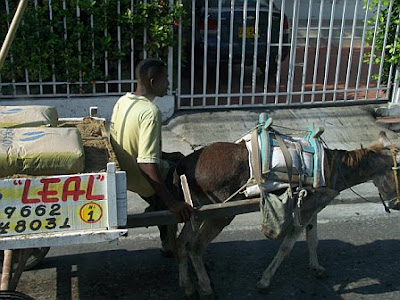 been in the same family for generations. Many more modest houses fill the blocks. Open door ways to shops show men playing checkers in the cool breeze by the opening. Donkey drawn carts are a common site in the old city a UNESCO World Heritage Site.
I only had one day to explore the city, since I was on my cruise. The city's beat is definitely Latin in nature and vibrant. The colorful flowers cascading over balconies of the colonial town home would make Monet weep with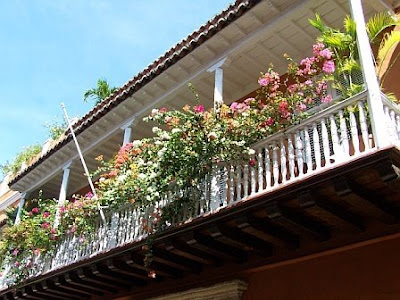 joy. The tanned svelte men in small swimsuits would raise the temperature ANYWHERE! So call Damron Vacations and experience where the 21st Century blends with the 16th. Were tall concrete and glass towers are the backdrop for a colonial mansion whose caretaker rode a donkey to work. Don't forget to look for Juan Valdez, and pick up some REAL Colombian coffee.
 With its growing wealth, it became an object of interest to the many pirates of the time. After a ransom was paid for the city to Francis Drake in excess of $200 million US in today's market, the Spanish government paid for defenses to be built. With the construction of city walls and a massive fort, it became much harder to capture and plunder the city.
 Being part of the Spanish colonies, Cartagena followed the practices of the motherland. One unfortunate issue was The Inquisition. People were brought up
 on dubious charges out of revenge and paid dearly for it. The Palace of Inquisition is located in the old city on a bucolic square. Inside it has been converted to a museum featuring the equipment used to extract
  confessions. Most seem QUITE painful.
Along the beachfront on a peninsula jutting into the harbor entrance is a forest of new high rise
 buildings. These gleaming towers of white with blue windows and balconies could be along Miami's famed beachfront. This is where the wealthy in Columbia either live or have a vacation home.
Back in the old town, traditional architecture is still the predominate theme. There are still some of the old colonial mansions surrounded by gardens that have
 been in the same family for generations. Many more modest houses fill the blocks. Open door ways to shops show men playing checkers in the cool breeze by the opening. Donkey drawn carts are a common site in the old city a UNESCO World Heritage Site.
I only had one day to explore the city, since I was on my cruise. The city's beat is definitely Latin in nature and vibrant. The colorful flowers cascading over balconies of the colonial town home would make Monet weep with
 joy. The tanned svelte men in small swimsuits would raise the temperature ANYWHERE! So call Damron Vacations and experience where the 21st Century blends with the 16th. Were tall concrete and glass towers are the backdrop for a colonial mansion whose caretaker rode a donkey to work. Don't forget to look for Juan Valdez, and pick up some REAL Colombian coffee.
Monday, March 2, 2009
How GRAND is Cayman?
 Grand Cayman is the largest of the Cayman Islands. With approximately 76 square miles it dwarfs Cayman Brac's 14, and Little Cayman's 10. Though Cayman Brac has a 140 foot high bluff, making it the tallest. With the airport and cruise terminal in Georgetown on Grand Cayman, it is the entrance for most tourists.
On Grand Cayman, the west end of the island is the most developed around the capital. Downtown Georgetown resembles most Caribbean capitals. Lots of shops offering duty free good, local handicrafts and souvenirs. Jewelry, alcohol and watches predominate for the duty free goods. Rum cakes is a specialty of the island and worth a visit to one of the many shops. Free samples are provided along with a shot of local rum. Just do not make it an all you can eat buffet, there are others waiting.
When discovered by Columbus in 1503 on this 4th voyage to the New World, the islands were populated by turtles and was named Las Tortugas. In the 1530s the name Largartos was used meaning alligator or large lizard. This eventually changed to Cayman, the local Indian name for the reptiles. The proliferation of turtles made it a popular stop for ships to gather meat for their crews.
After being depleted, the ships searched elsewhere for a new supply. Currently on Grand
 Cayman there is a large turtle farm. While some of the turtles are sold for meat, most are released to the wild to replace the native stock, to great success. Caymans and blue iguanas area also raised there.
 One popular destination for tourists is an area of black limestone rock called Hell. The origin of the name is lost to history, but has stuck. Many shops in the area offer postcards, t-shirts and souvenirs from Hell.
Since it is a Caribbean Island, it is ringed with stretches of beautiful beaches. The most famous is 7 mile beach, not far from Georgetown and the airport. Along this
 fantastic stretch of sand are most of the large hotels and resorts. It is a great place to snorkel and just catch some sun.
The Cayman Trench is a popular scuba diving spot. The shallow water drops off to a maximum of over 25,000 feet, making for a spectacular setting for wall diving. For people that do not
 scuba, there are several submarine rides that offer
  a view of the undersea world. Another area for water recreation is Stingray Bay where the gentle creatures interact with bathers.
My visit to Grand Cayman was about a Celebrity cruise. The government in the past has turned away gay cruises and there is little alternative lifestyle on the island, so if you are looking for a full on gay vacation, Grand Cayman is not a good choice. But as a stop on a cruise it is a nice port of call. So if you want to try the Caribbean on a Celebrity cruise, or any of the other major lines, contact Damron Vacations and get the wheels rolling. Do not forget that starting in June, 2009, a passport will be required for all re-entries into the United States. Up until then a birth certificate was all that was needed.
Subscribe to:
Posts (Atom)